As Prof. Porter's class description indicated, and our class discussion sometimes underscored, Romanticism is the artistic response of a culture “on the cusp of the Industrial revolution and in the midst of political turmoil and war.” (8/21) The Romantic poets whom we have read were moved by the social, religious, scientific, and political tensions peculiar to their time to ask certain questions in their effort to make sense of a new and developing culture with respect to a traditional, pre-industrial culture: What are silence, solitude, and seclusion worth when one considers the benefits of burgeoning urbanism? And where can they still be found? How does the pious man react to On the Origin of Species? What is the value of an unplowed field, or a column of flowers in the face of the growth of a “system of natural liberty”? ( IV.9.51) It is through these questions, and many similar ones, that our class has tried to understand the role poetry has in this dialogue. In assessing a few poems, including Robert Burns's “To a Mountain Daisy,” William Wordsworth's “Lines Composed a Few Miles Above Tintern Abbey, on Revisiting the Banks of the Wye During a Tour. July 13, 1798,” Walt Whitman's “Song of Myself,” and Algernon Charles Swinburne's “The Garden of Proserpine,” I try to map how poets of the Romantic movement confront various cultural tensions produced by the industrial revolution and contemporary scientific thought.
In 1786 Robert Burns composed “To a Mountain Daisy.” The narrator's reflection on the meeting between a daisy and his plough characterizes what we could, perhaps, call the "initial" romantic reaction to industrialism. Burns, as Victoria points out in her post entitled “Man's Power Related to Nature” (8/31) characterizes the relationship as fatalistic, doomed to fail before it's even begun: “one could say that Burns' first stanza shows that the effect of man on nature is destructive . . . man only has the potential to destroy nature, rather than construct or add to it.” Indeed, the act of violence on which the poem meditates, the crushing of the daisy under the plough, is so final and irreversible: “To spare thee now is past my pow'r . . .” (l. 5) that describing the act itself is meaningless--to ascribe any volition to the narrator during the incident, or provide any context, be it in justification or not, is superfluous. There is only one potential outcome from this encounter: the daisy's death. This relationship, as Victoria additionally alludes to, and as Devon points out (8/31), is indicative of Williams's idea of nature as wilderness: “Nature, in this new sense, was in another and different way all that was not man: all that was not touched by man, spoilt my man: nature as the lonely places, the wilderness.” (Williams, 77) In this sense, nature is the absence of man's touch, a point of view which explains why--apart from chronology, of course--Burns best represents the "initial" romantic response to industrialism. Burns's reaction is highly dramatic, fatalistic, closed-minded. There is to be no reconciliation of the old and the new, only destruction and replacement. When the daisy is destroyed, the field ceases to be the home of a daisy. It becomes, instead, part of the burgeoning global economy, an entity which catalyzes man's veritable consumption of nature and transformation of it into something completely lifeless.
Twelve years after Burns publishes “To a Mountain Daisy,” Wordsworth in 1898 publishes “Tintern Abbey.” In it, he presents a departure from Burns's reactionary response to industrialism. Rather than condemning man and progress as arbiters of destruction, he seeks to understand man and nature as similar, possibly coexistent entities. In "Tintern Abbey," Wordsworth describes a changing and maturing understanding of nature. During his previous visit, five years ago, during “boyish days” (l. 73), he gave no special thought to his experience of nature. He simply "like a roe/ . . . bounded over the mountains, by the sides/ Of the deep rivers, and the lonely streams,/ Wherever nature led." He was aware of nature purely as a picturesque environment: “Their colours and their forms, were then to me/ an appetite; a feeling and a love,/ That had no need of a remoter charm,/ By thought supplied, nor any interest/ Unborrowed from the eye.” (ll. 79-83) Nature was a pure spectacle, an environment that evoked only visual wonder. He indicates that in the years that have passed, his separation from this natural environment has deepened his appreciation for it. Deprivation from the spectacle has given him a more profound understanding of it, and in these moments of solitude: “oft, in lonely rooms, and mid the din/ Of towns and cities, I have owed to them,/ In hours of weariness, sensations sweet,/ Felt in the blood, and felt along the heart;/ And passing even into my purer mind,/ With tranquil restoration. . .” (ll. 26-30), Wordsworth has discovered a much more profound power in nature, a power far beyond that which impelled his youthful self to be awestruck by a visual spectacle. It is this Wordsworth who is returning to the abbey, and he is a of a different personal disposition and social context. He is a more culturally informed observer, who claims, “. . . For I have learned/ To look on nature, not as in the hour/ Of thoughtless youth; but hearing oftentimes/ The still, sad music of humanity. . . . And I have felt a presence that disturbs me with the joy/ Of elevated thoughts; a sense of sublime/ Of something far more deeply interfused.” (ll. 88-96) Bates notes that “Wordsworth . . . refuses to carve the world into object and subject; the same force animates both consciousness ('the mind of man') and 'all things.' . . . Wordsworth says . . . that the distinction . . . between subject and object is a murderous dissection.” (Bates, 147) Adam mentions in his post “Written a Few Miles above 'Normal'” (9/19/11) that the key to Wordsworth's ecological understanding of nature is contained in the lines that Bates is alluding to: “a sense sublime . . . whose dwelling is the light of setting suns/ . . . and in the mind of man. . .” (ll. 95-97)
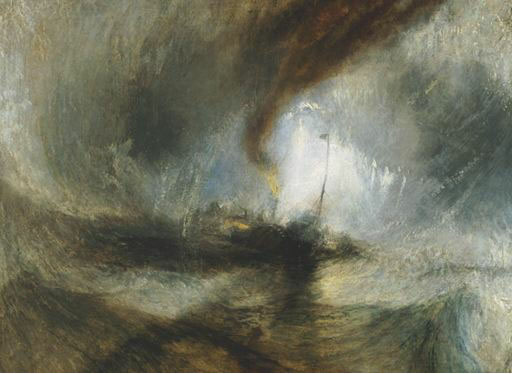
Before looking at Whitman, a little detour through the world of art may be opportune. Let's look a pair paintings by Joseph William Mallord Turner. First consider his "Snow Storm--Steam Boat Off a Harbor's Mouth Making Signals in Shallow Water," painted in 1842.
In "Ruskin's Theories on the Sublime" George P. Landow points out that, “in place of the static composition, rational and controlled, that implies a conception of the scene-as-object, Turner created a dynamic composition that involved the spectator in a subjective relation to the storm.” Turner, in other words, doesn't aim at producing a painting that reinforces a sense of nature as separate from the viewer. Instead, someone looking at "Snow Storm" has an experience similar to that felt by the mature narrator of "Tintern Abbey; both are touched by “A motion and a spirit, that impels/ All thinking things, all objects of all thought,/ And rolls through all things. . .” (ll. 100-102)
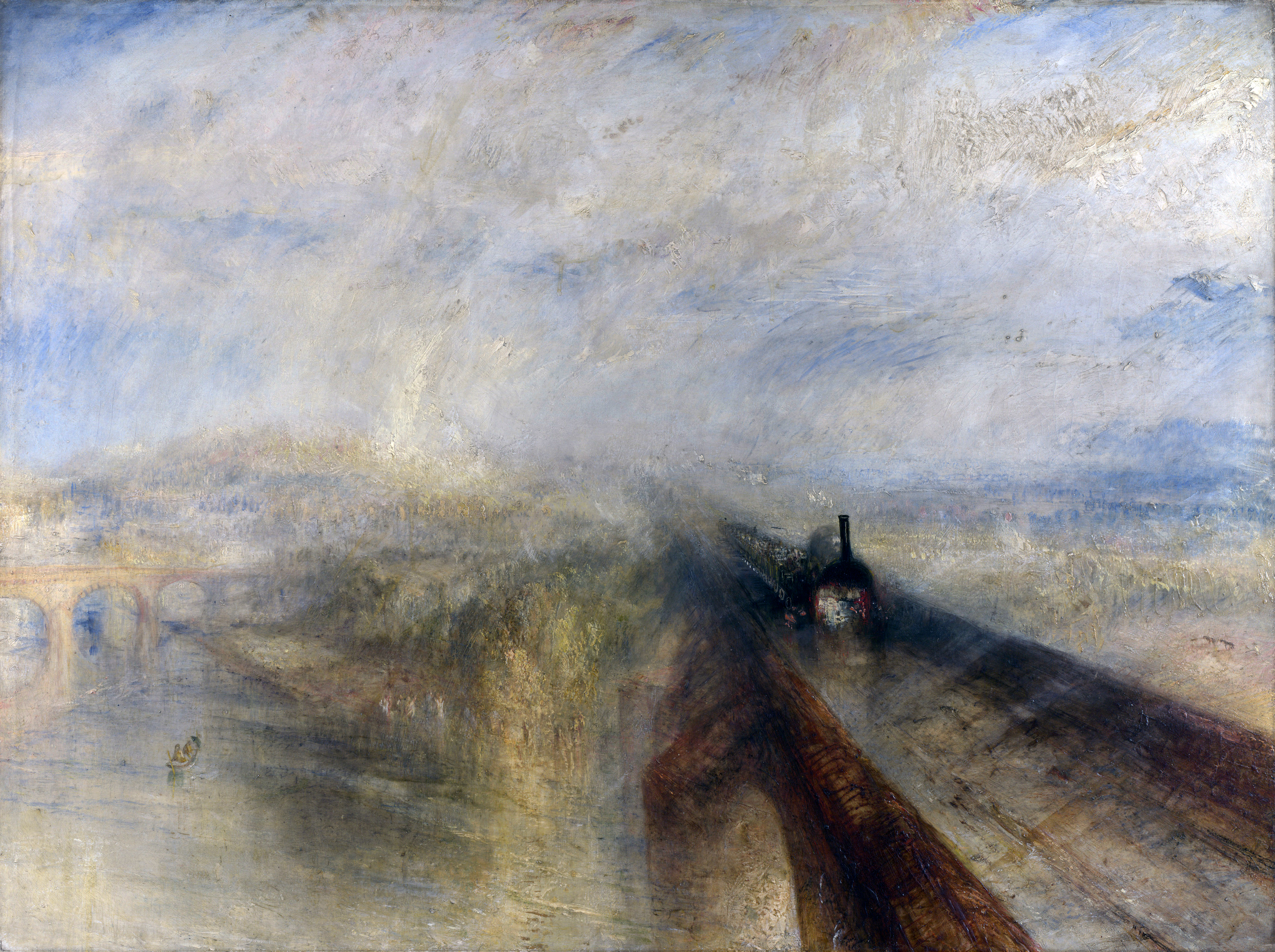
A second painting by Turner that suggests the same Wordsworthian fusion between man and the natural environment is "Rain, Steam, and Speed-The Great Western Railroad," painted in 1844.

Rain, Steam, and Speed – The Great Western Railroad
Turner's painting has several interesting components when considered in relation to “Tintern Abbey.” First, the light. At Tintern Abbey, Wordsworth feels "a sense sublime/ Of something far more deeply interfused,/ Whose dwelling is the light of setting suns" (ll. 96-98). In "Rain, Steam, and Speed," light is the dominating force, not only occupying the physical majority of the painting, but also, within the picture, occupying the rails of the railroad itself. Further, the train and the rail system, arguably the most emblematic image of the industrial revolution, are interfused and, in a sense, dominated by the light.
Whitman's “Song of Myself” (1855) is published just over half a century after of “Tintern Abbey" and offers the resolution of the early anxieties of the Romantic poets in response to the Industrial Revolution, as well as the perfected harmony of religion, man, and nature that Wordsworth grasped to express. In the opening lines, the poet declares to the reader “And what I assume you shall assume,/ For every atom belonging to me as good belongs to you.” (ll. 2-3) This kind of relationship exceeds the symbiosis Wordsworth implied: the most tangible part of us, our very matter, is not our own, but rather part of all of us. Whitman's exploration of the essential qualities of objects, particularly in part 6, is fundamental to his overall message. He is confronted by a child, who poses a simple question “What is grass?” His response details a multitude of answers. First the grass is “the flag of my disposition,” then “it is the handkerchief of the Lord,” then it “is itself a child, the produced babe of vegetation,” then “a uniform hieroglyphic,” and then it becomes “the beautiful uncut hair of graves.” What is clear is that, beyond the question being a difficult one, the answer doesn't lie in one response. There is no “correct” answer, no essential quality of grass that singularly defines it. Grass is all of these things. These definitions are born out of science, of poetry, of war, of religion, etc. And this is reassuring to Whitman, this sense of the infinite, this idea that individuals are capable of finding many meanings in an object, meanings that are equally essential as the object's scientific definition, or definition in relation to war or to political controversy. Whitman's poet has come to terms with a world newly defined by industrialism and scientific progress--in fact, he welcomes new definitions, for with them come just as many individual schematics of perception grafted upon one world, and one man's world set beside another's, ad infinitum. The philosopher George Santayana spoke to this wide embrace of the variety and multiplicity of life in Whitman in an essay published some 45 years after the publication of "Song of Myself." In “Walt Whitman: A Dialogue” Van Tender, Santayana's defender of Whitman, asserts:
“It's not a theory or a description of things I get from Whitman. It's an attitude, a faculty of appreciation. You may laugh at his catalogues of objects, at his enumeration of places. But the hurrying of these images through the mind gives me a sense of space, of a multiplicity of things spread endlessly around me. I become aware of the life of millions of men, of great stretches of marsh, desert, and ocean. Have you never thought of the poetry of the planet?. . . That is his great merit, his sublime justice. It is a kind of profound piety that recognizes the life of every thing in nature, and spares it, and worships its intrinsic worth.”
Swinburne's “The Garden of Proserpine” (1866) marks what I like to think of as the waning of the Romantics, and that's why he's known as a decadent poet to most, as Devon pointed out in her post “Swinburne” (11/14). Margot K. Louis notes, in her essay “Proserpine and Pessimism: Goddesses of Death, Life, and Language from Swinburne to Wharton”: “Algernon Swinburne in his Proserpine poems sets the agenda, demonstrating (and applauding) the threat to Christianity (and to any stable system of meaning) implicit in a pessimist view.” “The Garden of Proserpine” is a poem submerged in weariness and deeply conscious of its post-Darwinian context: “I am tired of tears and laughter,/ And men that laugh and weep;/ Of what may come hereafter/ For men that sow to reap. . .” (ll. 9-12) The narrator is exhausted by continuous discourse concerning the fate of man, and about how this life may affect the next. Many religious sects were incapable of reconciling their theology with Darwin's Origin of the Species, and many interpreted its publication as an affront to God's existence--a situation that this poem indicates Swinburne found both exhausting and meaningless. The narrator is tired, as well, of the ambitions and drive that characterize the industrial revolution, "I am weary of days and hours,/ Blown buds of barren flowers,/ Desires and dreams and powers/ And everything but sleep." (ll. 13-16) He feels more comfortable surrounded by the aimlessness of those who inhabit the garden: “They drive adrift, an whither/ They wot not who make thither;/ But no such winds blow hither/ And no such things grow here.” (l. 21-24) Warren's post “Duality” (11/16) indicates the incessant use of opposing concepts in the poem: “Life/Death, Winter/Summer, Awake/Sleep, etc. . .” Swinburne is highlighting the innumerable forces that are at odds in the world, and complaining of the toll life brings: "We thank with brief thanksgiving/ Whatever gods may be/ That no life lives for ever;/ That dead men rise up ever;/ That even the weariest river/ Winds somewhere safe to sea." (ll. 83-88)
Beginning with Burns's fear of the destruction modernity brings, to Wordsworth's meditation on an evolving coexistence between man and nature, to Whitman's idealized, perfect union of all matter and energy in the world, to Swinburne's radical rejection of this world as one emptied of meaning by endless opposition, we effectively plot the waxing and waning of the Romantic period through historical artifact. That is, we are seeing these poems as emblematic moments of their time. But this is just half the story, and here I believe is where we begin to attempt to answer the grand question of this class: Can poetry save the earth? The reason we treat these poems as artifacts is that they capture a sentiment in their historical context. They are both highly conscious of the moment in which they exist, and also forward thinking. And this is the mark of a good of poetry, that it maintains a degree of truth, that it captures experience and feelings that readers identify as important. The value of "earth-saving" poetry lies not just in the beauty of the words, the inventiveness of the meter, the playfulness of the rhyme, or the depth or quantity of allusion. The power of poetry to save the earth lies in how powerfully it compels the reader to think, to internalize a set of values or an aesthetic framework, to recognize a loss and embrace a new vision, and to yearn to share the vision of the poem. Poetry, like any art form, must only resonate with the receivers of the art to create change. It contains the seeds of thought and visions of better worlds. It inspires an impulse to contemplate, and it may stir others to act to change, to liberate, to save, and to protect the earth.
Citations
Bate, Jonathan. The Song of the Earth. Boston: Harvard University Press, 2002.
Williams, Raymond. Culture and Materialism. New York: Verso, 2005.

No comments:
Post a Comment